Login to the Admin Console from the Server
The installer created a shortcut named “DualShield Admin Console” and placed it on the desktop of the server machine.
Double click the icon to launch the DualShield Admin Console (DAC).
Logon for the first time with the following default credentials:
- Username: sa
- Password: sa
You will be prompted to change the password. Please follow the prompts.
If you selected to install the legacy DualShield Management Console (DMC), and want to use DMC instead, click the link below to get started:
Login to the Admin Console from a PC
If you want to access the DualShield Admin Console from other PCs in your network, then you need to make following changes in your DNS and firewall:
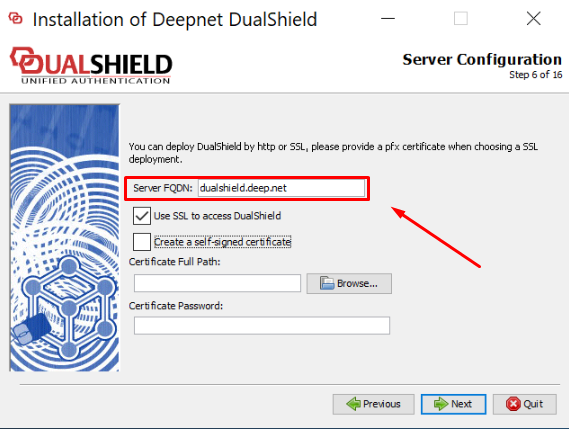
The DualShield Server FQDN, described in our wiki guides, means the FQDN used to access the following service consoles, including
- Admin Console
- User Console
- Single Sign-On Console (mainly used for SAML SSSO)
- Deployment Console (for device and tokens)
DualShield consoles are all web-based portals that can be accessed with a web browser. The FQDN is the web address of the DualShield consoles.
In the example below, the DualShield Server FQDN is being used to access the DualShield Administration Console.
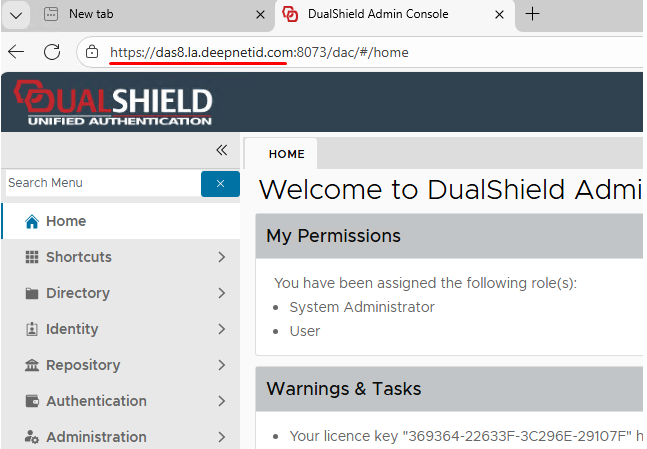
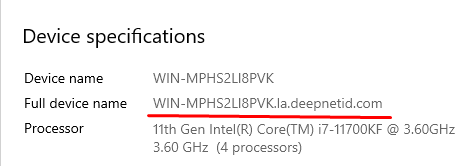
Please do not confuse it with the FQDN used as the full device name of the hosting server:
If the DualShield server is a backend server located in the internal network and to be accessed from internal PCs and workstations, then the DualShield's FQDN must be added into the internal DNS server.
If the DualShield server is a frontend server located in the DMZ and to be accessed from external PCs and workstations, then the DualShield's FQDN must be added into the external DNS server.
If the DualShield server is an all-in-one server that is accessed from both internal & external PCs and workstations, then its FQDN must be added into both the internal & external DNS servers.
If you wish to change the DualShield Server FQDN after installation, then please refer to our wiki guide: Change DualShield Server FQDN
To access your DualShield's admin console from other PCs in your network, open a browser* and enter the URL below:
https://your-dualshield-fqdn:8073/dac
*Please note that DAC is not supported on Internet Explorer. We recommend using Edge, Chrome or Firefox.